
Republic of Croatia (Hrvatska)

Located in deep into Karlovac County, central Croatia, lies the Petrova Gora Monument or Spomenik ustanku naroda Banije i Korduna in Croatian.
The monument celebrates the uprising and resistance movement of the people of Kordun and Banija against nazi-fascism and commemorates the victims, both civilian and fallen resistance fighters. Today it lies in complete ruin. What was once a beacon of hope and resistance to Nazi fascism has been left to vandals and nature. The shameful legacy of homegrown fascism is not a point of pride in Croatia and like most beacons of that shameful past, it is slowly being whitewashed out of history.
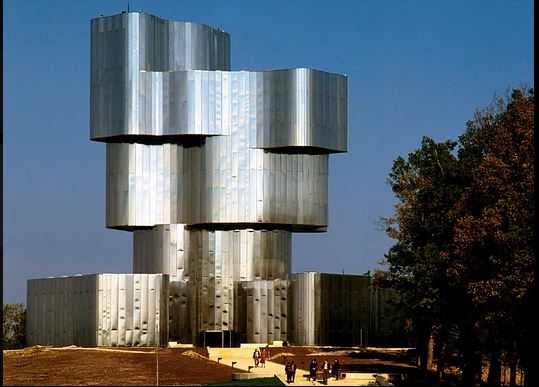
This monument and museum was dedicated to the deaths of ethnic-Serb peasants who died fighting against the Ustaše militia in the Petrova Gora mountains, most notably during 1941 and 1942.
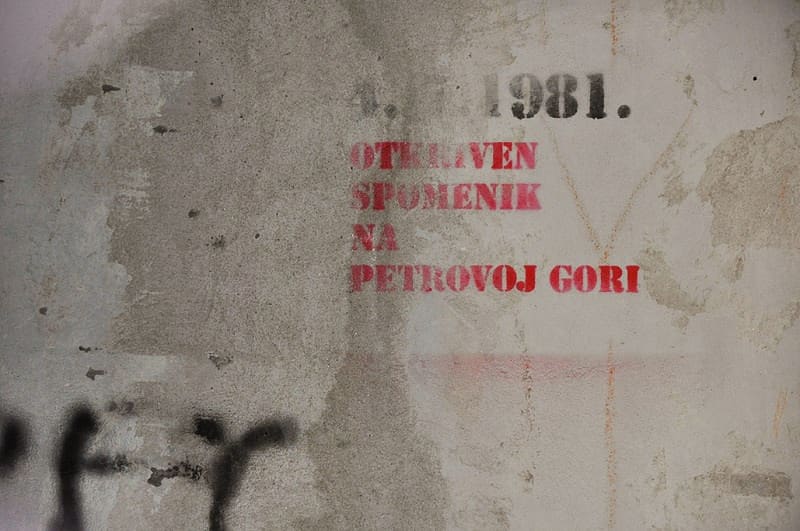
Beginning in the summer of 1941, ethnic-Serbs across the newly created Independent State of Croatia were starting to be forcefully removed from their homes by Ustaše militiamen, who were then deported to Serbia. Peasants in this region feared the same fate awaited them.
In mid-1941, the communist fighters, learning of this unrest among these persecuted ethnic-Serbs, infiltrated the heavily occupied Kordun and Banija region. On July 19th, 1941, representatives from the Communist Party of Croatia made the decision to launch an armed uprising.
The Partisan forces then proceeded to convince hundreds of ethnic-Serbs to rise up and create an organized resistance against the Ustaše’s deportation efforts. After forming this alliance, the Kordun Partisans, who number around 2,500, then established a headquarters near the summit of the Petrova Gora mountain range.
Around 15,000 people, men, women and children, from the surrounding region came to the mountain under the protection of this Partisan stronghold. The uprising officially began on July 27th, 1941.
On March 19th, 1942, in response to this uprising, the Ustaše militia began “Operation Petrova Gora“, an offensive intended to rid the Petrova Gora region of all ethnic-Serbs resistance and Partisan rebel fighters. However, the Ustaše offensive only escalated the uprising and ethnic-Serb anger increased further, a fact which allowed Partisans to grow stronger and rally more peasants to arms (many just being simple shepherds and farmers).
However, during a sudden breakthrough of defenses in early April of 1942, Ustaše forces stormed multiple positions around Petrova Gora. Surprised and only minimally armed with pitchforks and simple weapons, many hundreds of ethnic-Serb peasants who sought refuge on the mountain top charged towards Ustaše soldiers. They stood little chance against the trained and armed soldiers, and over 300 ethnic-Serb peasants were killed.
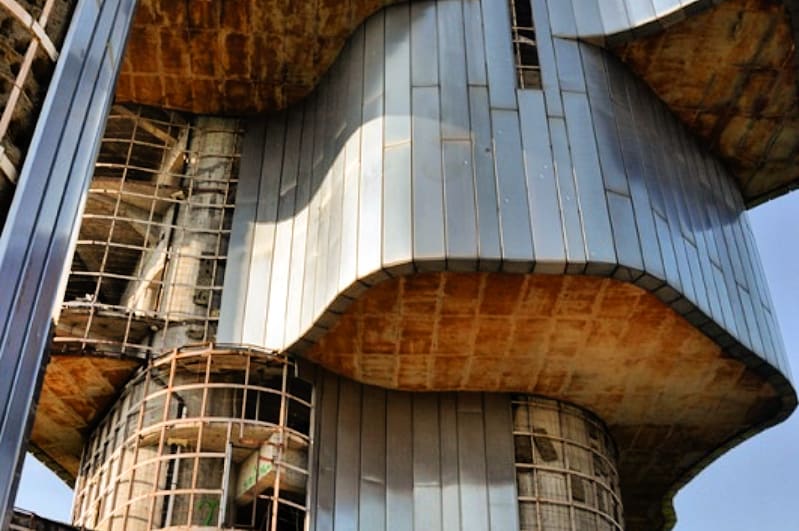
As the control of the Petrova Gora range fell into the hands of the Ustaše in early May of 1942, a few Partisan units managed to evacuate. Of the hundreds of ethnic-Serb peasants captured by the Ustaše, the ones who were not executed were sent to concentration camps across the region, most notably Jasenovac. During the course of the war, roughly 27,000 people from the Kordun region were killed.
With the onset of the Yugoslav Wars in the 1990s the monument at Petrova Gora fell into disrepair and was targeted and attacked by vandals. Over the subsequent decades it became completely defaced, looted and demolished, with all its historical artifacts and relics contained within its museum and archives being taken or destroyed. This site may have been targeted with a particular amount of abuse and neglect on account of its cultural importance to the region’s ethnic-Serb minority.

To this day the Petrova Gora site is still under no official protection, and, having unclear ownership, it continues to fall into further degradation.
Security cameras are placed around the complex, but it is unclear to what degree such measures have been effective or utilized in intercepting vandals or those who wish to destroy the complex.


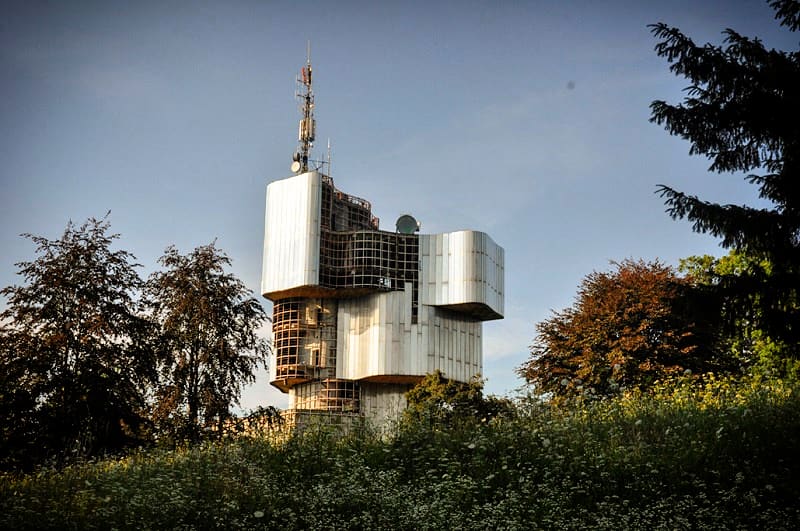
In an additional insult to those who still honor this monument site and wish it to be repaired, a series of communication antennas were mounted on top of the structure over recent decades. Some sources estimate that the full cost of rehabilitating and repairing the entire Petrova Gora complex would cost well over tens of millions of euros.
Yet, despite this large cost, within the last few years, numerous organizations and groups have come forward with creative concepts for using the monument space, as well as developing restoration initiatives.
Along the walkway up to the monument from the parking lot, halfway up you will find a circular granite stone altar (pictured below). Around the top outer edge of it, there is an engraving written in both Croatian and Serbian. The engraving roughly translates to:

“Within the foundation of our earned freedom is the peak of Petrova Gora, always our mother mountain.”
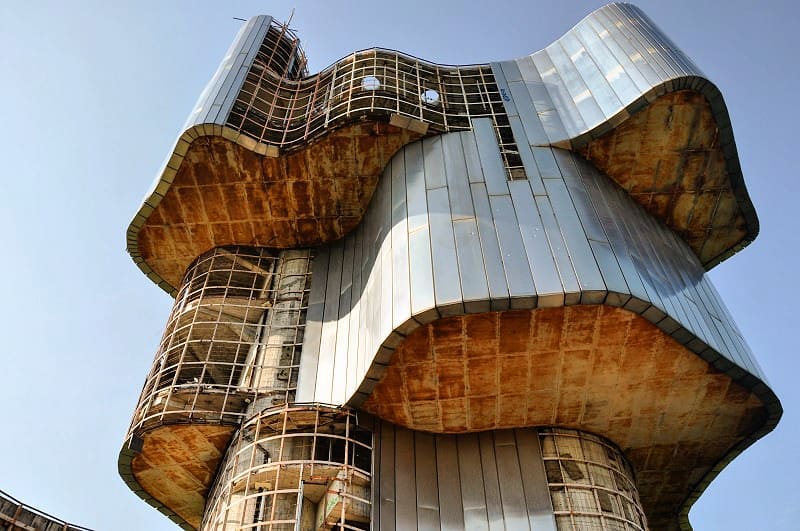
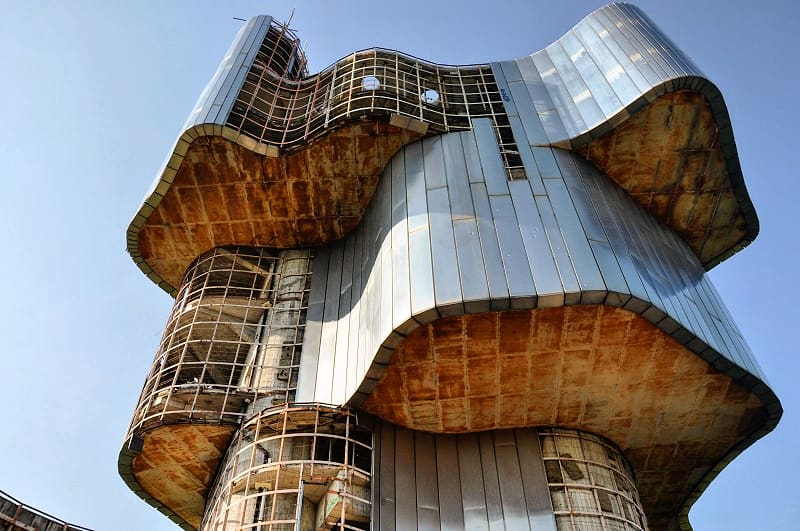
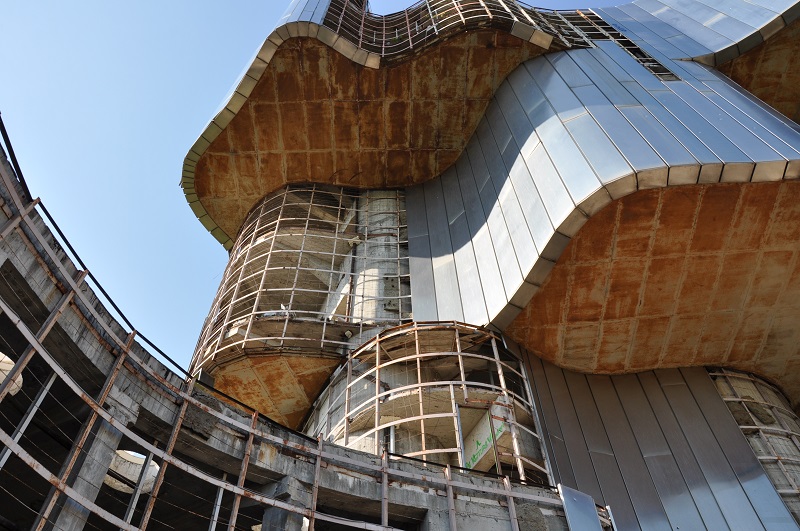
According to designer Vojin Bakić there are symbolic meanings to the reflective properties of the Petrova Gora monument. When the sun is set at just the right angle on the horizon, the polished metal panels of the structure is illuminated in a bright yellow/red show of colors. This effect is especially apparent when looking up at the monument from a distance in the lower valleys towards Vojnić.
This amplification of the monument’s reflective effect the symbolizes properties of ‘light overcoming darkness‘, it also results in the monument giving off the appearance of being a sort of beacon or lighthouse.
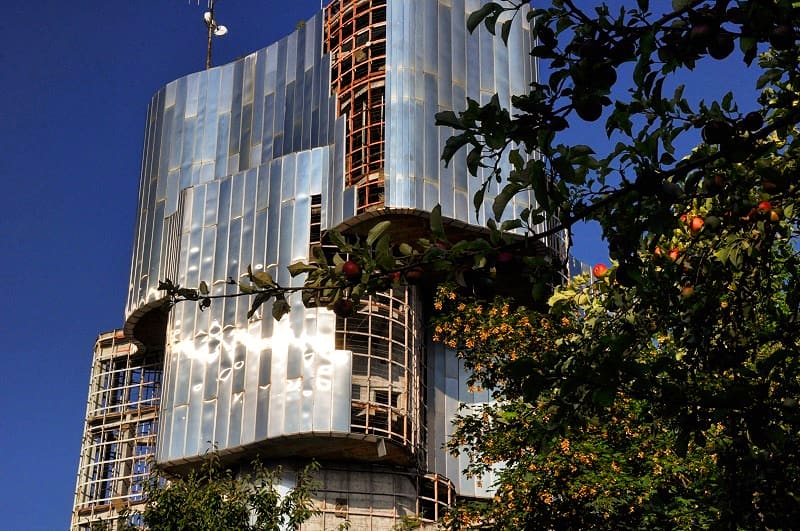
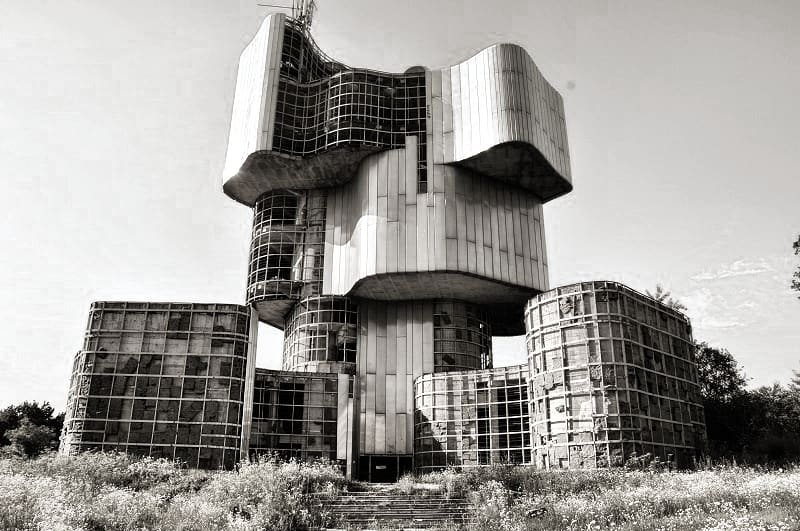
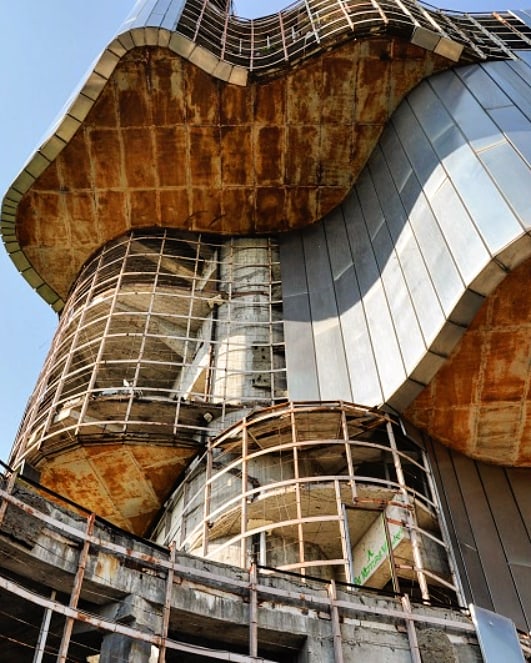
There is no way to describe the state of this monument here at Petrova Gora other than complete destruction, decay and abandonment. After the start of the Yugoslav Wars in 1991, the neglect and degradation of the exterior of this site began almost immediately, then, after 1995, the interior museum was also destroyed.
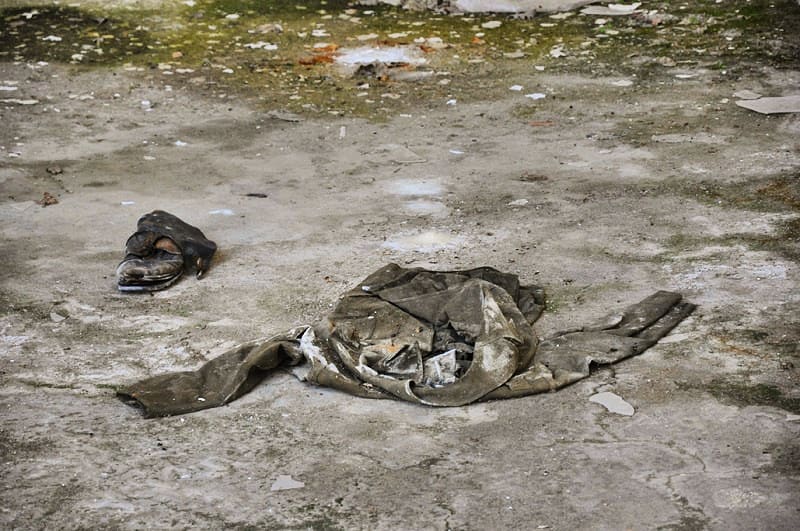
What remains now is a hollow husk of the structure, being held up by a massive concrete skeleton. The majority of the stainless steel panels have been stolen, while pieces of rotted insulation are scattered around the entire monument, inside and out.
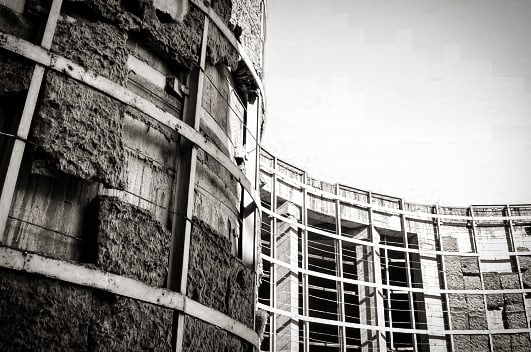
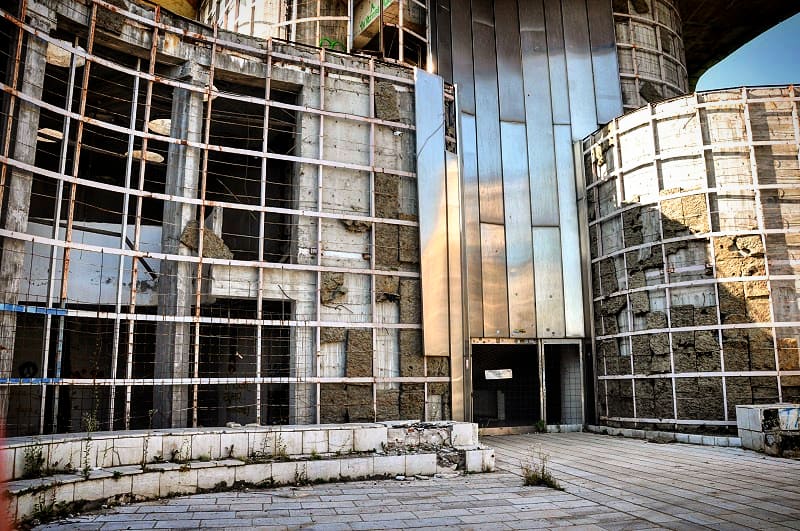

The basement level is flooded and inhabited by animals. Meanwhile, the elevator-shafts lay wide-open, exposing a pitch-black void. The front of the building is gated and fenced in, however, holes have been made in the fences to allow entrance to the structure.
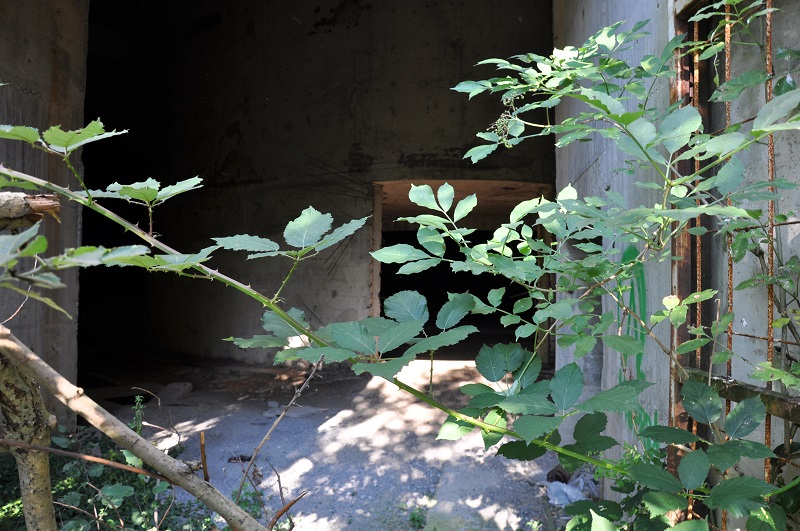
If you are thinking of gaining entry… it is possible, however as I mentioned, there are multiple security cameras and since recent interest has been shown in repairing or re-purposing the property you might run into some trouble. Plus with all the theft of the material and contents it might not be taken so lightly if you were to be caught.
We spent about 2 hours exploring the site and we did not run into anyone else. However, on our way back down to the main road we did see a police car heading our way. However, it may have been purely coincidence.
Many parts of the interior levels are can be extremely dangerous as well. In addition, the structure is littered with concealed open shafts and extreme falling hazards. If you do enter, you do so at your own risk and be extremely cautious.
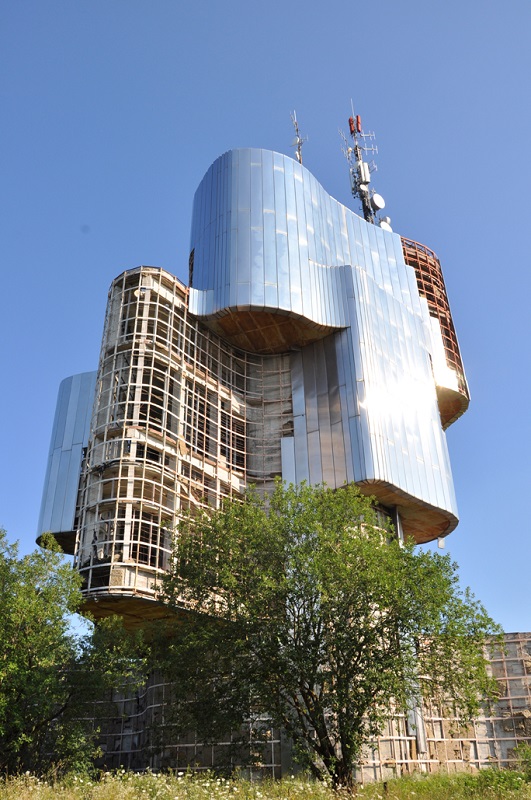

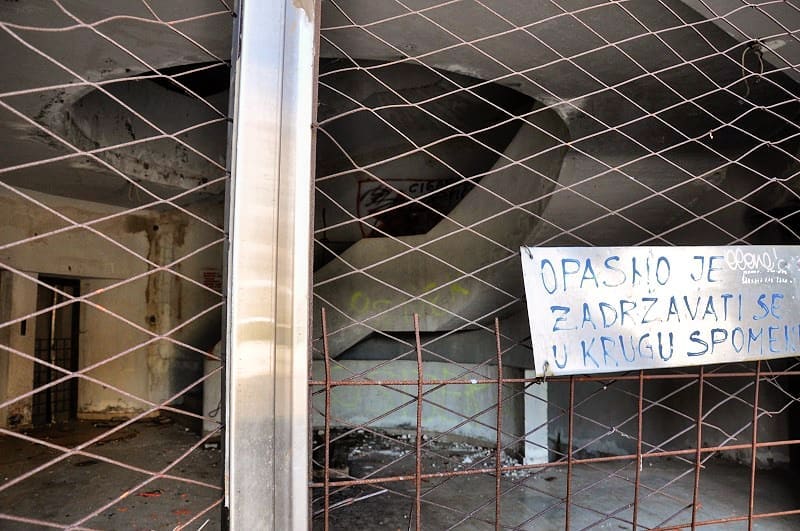
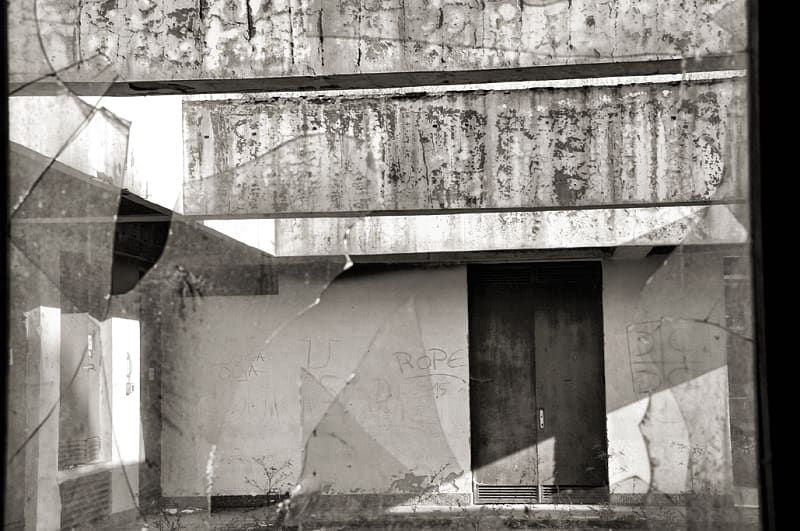
Meanwhile, the old visitor center at the base of the monument by the parking lot is also completely destroyed and abandoned, picked clean of anything even remotely of value. It is mostly open for exploration… although you won’t find much.
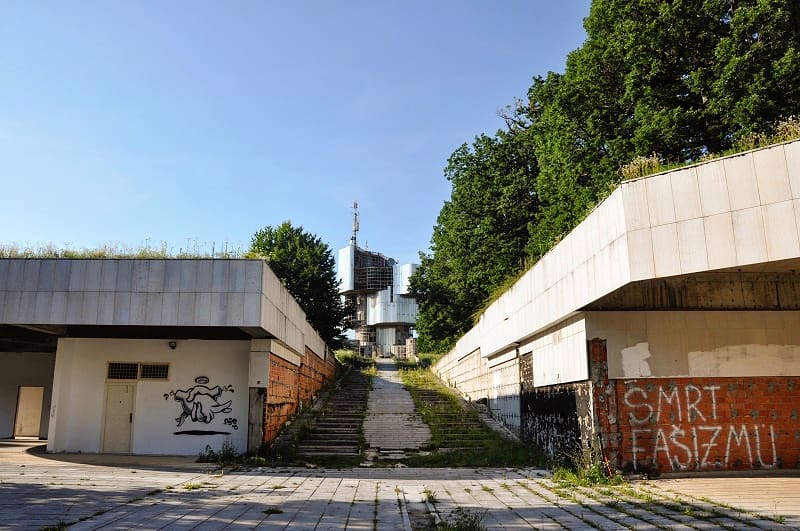

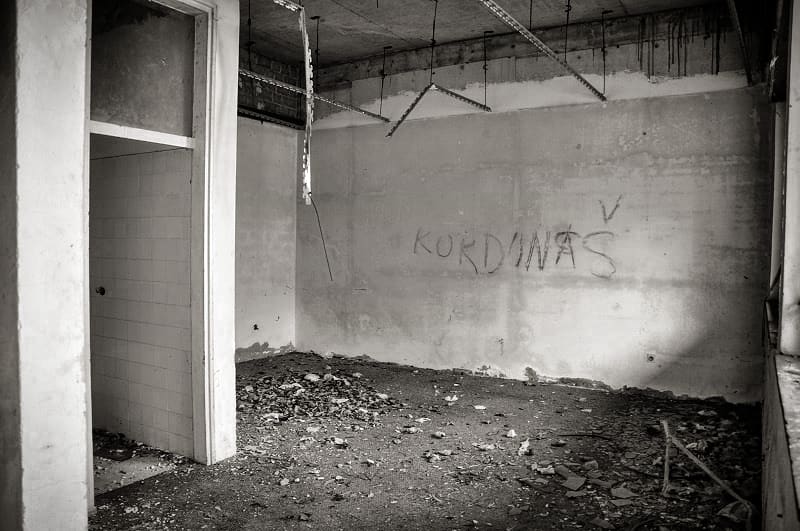

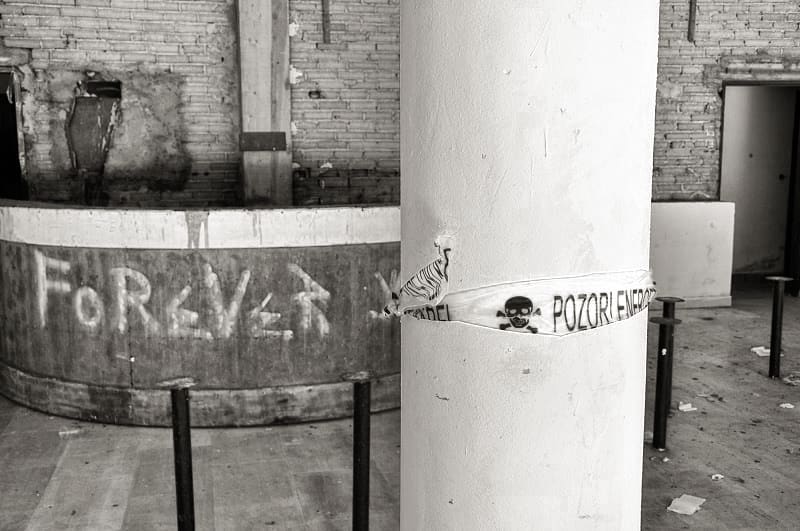
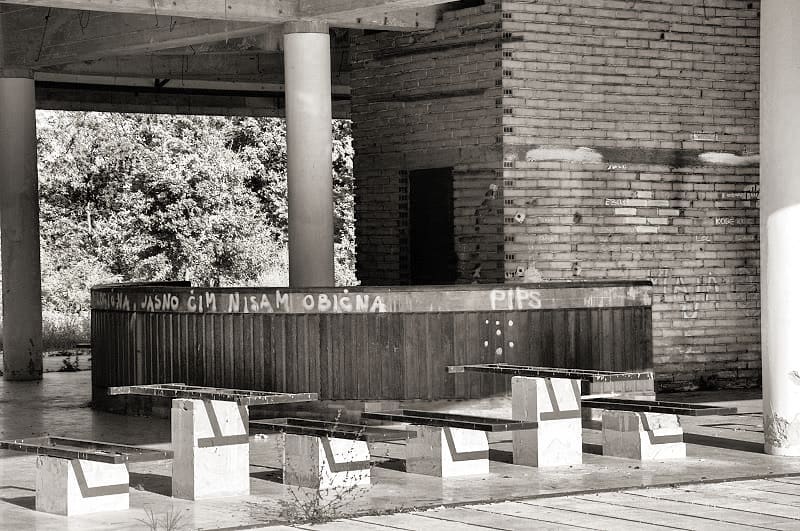
In recent years, radio towers and other communication structures have been attached to the top of this monument, which take advantage of the site’s strategic positioning and elevation at the top of Petrova Gora mountain.

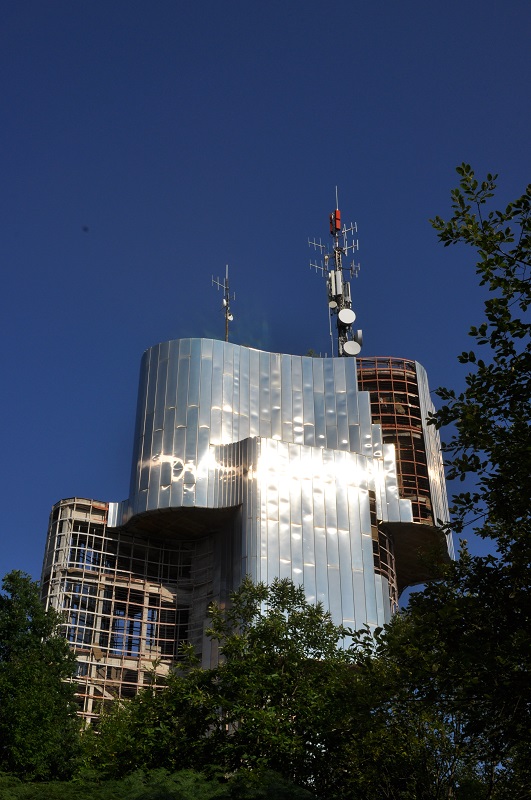
This move has angered certain groups aiming to eventually restore and rehabilitate this monument, who argue that these towers deface and disfigure a piece of Croatia’s historic and cultural legacy.

Location : 45°18′58.9″N 15°48′17.6″E
Directions : From Highway 6 in Vojnić, turn onto Gornji Vojnić road heading towards Radonja. Once in Radonja, follow the signs leading you into Petrova Gora Nature Park up through the Radonja River valley. From here, follow the “Spomenik” signs, which will take you all the way up to the monument at the top of the mountain. There is an easily accessible parking lot directly in front of the monument in the old visitors center.



 emily & entropy
What an interesting building. I can only imagine how beautiful it must have been.
LikeLike
I want to go!
LikeLike
lets go!
LikeLike